Tiles in Hole: Black Hole
- 4.8
- Rating
- 5.00M
- Installs
- Free
- Price

 Analysis by App-foxy
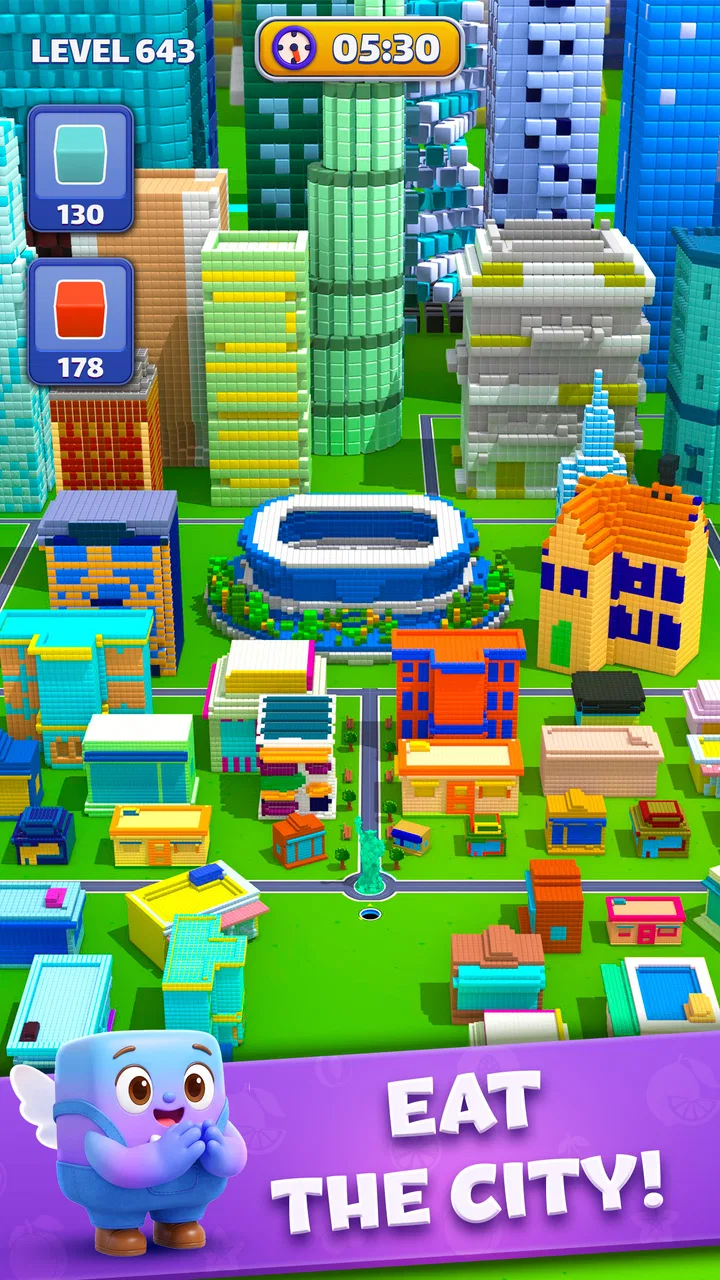
I expected a simple time-filler from Tiles in Hole: Black Hole, and that is exactly where its appeal begins. You guide a black hole across a tiled play area, swallow pieces, become larger, and use that growth to reach tiles that were previously out of range. The idea is easy to understand in seconds, but the changing size gives each short attempt a small sense of progress. I always know what I am trying to do: collect enough tiles to make the hole more capable before the session ends.
This is a casual game from LIHUHU PTE. LTD., available free of charge for players looking for quick, low-pressure entertainment. It is rated for Everyone, and the current version is 1.1.1.1. The game has already passed the one-million-install mark and holds an average rating of 4.9 from roughly thirty-one thousand ratings, which fits my impression that its straightforward loop is easy for a wide audience to pick up.
How the black hole loop works in practice
I find the black-hole loop most satisfying when I treat movement as a small route-planning problem, not just a hunt for the nearest tile. In this section, I’ll look at how early choices shape the pace of a run and why collecting efficiently can feel more rewarding than simply moving quickly. That practical rhythm also helps explain where the game’s simple design is a strength—and where it may leave some players wanting more.
You May Also Like

 Google Keep - Notes and lists
Google Keep’s Quiet Growth Shows the Appeal of Simpler Notes
As mobile work gets busier, Google Keep keeps winning a simple contest: capture a thought quickly, find it later, and get on with the day.

 Blood Strike: 2.5 Anniversary
Blood Strike’s Loadouts Turn Every Drop Into a Tactical Gamble
A close look at Blood Strike’s custom loadouts: how fast access to signature weapons reshapes its battle royale rhythm, rewards preparation, and narrows the gap between fights.

 Pandora - Music & Podcasts
Pandora’s Music Is Easy to Start, but Harder to Recover
Pandora’s strength is its low-effort path from a seed to a station. Its weak spot is how much confidence it asks you to place in connection, setup, and quiet recovery.

 8 Ball Pool
 Is Built on Rivalries, Rematches, and Routine
A close look at the rivalries, rematches, shared routines, and unanswered safety questions that turn a quick pool match into a persistent mobile community.

 Samsung Music
’s Quiet Strength Is Playing What You Already Own
Its reach comes less from spectacle than from dependable access to a personal library. That simplicity is both the app’s strongest retention engine and its ceiling.

 AccuWeather: Weather Radar
AccuWeather Review: A Quick, Clear Forecast for Everyday Decisions
For everyday plans, the best forecast is the one you can understand quickly. AccuWeather makes rain timing, radar, and local conditions easy to act on, with a few trade-offs.
More From Our News Desk



The first action is immediately understandable
The best part of the opening moment is that there is very little to learn before playing. I move the hole toward nearby tiles and watch them disappear as they are collected. That first action explains the central rule better than a long tutorial would: the hole eats tiles, and eating tiles helps it grow. There is no need to study a complicated character build, memorize a large control scheme, or understand a deep story before having fun.
That simplicity makes the game useful in situations where I have only a few minutes. I can start a session while waiting for an appointment, during a short break, or when I want something interactive without committing to a demanding challenge. The controls are more about positioning and timing than reflex-heavy button combinations, so the experience feels approachable even when I am not fully focused.
The first strategic decision appears almost at once. I can chase the nearest tiles for quick progress, or I can think about a route that keeps the hole moving through a dense area. Taking the closest piece is satisfying, but it is not always the most efficient choice. A slightly longer path can put several tiles within reach and help the hole grow sooner. That small choice gives the opening seconds more purpose than simple random collecting.
Growth changes what the player can reach
The hole’s size is the main source of momentum. At the start, some tiles feel too large or inaccessible, so I focus on the pieces that are manageable. After collecting enough, the hole becomes more capable, and the play area opens up in a natural way. I do not need a separate explanation to understand the reward: a larger hole visibly changes my options.
This creates a pleasant action-and-feedback rhythm. I choose a direction, collect a group of tiles, see the hole become more useful, and then reassess the remaining space. The feedback is visual and immediate, which is important in a game built around a single repeated action. If the collection effect were slow or unclear, the loop would feel empty. Instead, each successful movement confirms that I am making progress.
One practical tip is to avoid treating every visible tile as equally valuable. When several pieces are nearby, I prefer a route that keeps the hole moving rather than one that forces repeated corrections. Smooth movement matters because it preserves the rhythm of collection. I also try not to rush toward a larger target before the hole is ready; losing time on an unrealistic approach is less useful than clearing smaller pieces first.
The feedback rhythm keeps short sessions moving
What keeps me playing is not a complicated objective but the steady sequence of small confirmations. A tile vanishes, the hole grows, a new target becomes possible, and the board feels more manageable. This is a classic casual-game pattern, but the black-hole theme gives it a particularly clear visual explanation. The object is not merely earning points in the abstract; it is physically consuming the space around it.
The loop works best when I treat each collection as preparation for the next one. Instead of stopping after a single successful move, I scan for the next cluster and keep the hole’s path flowing. That approach makes the game feel more active than its simple rules suggest. It also gives me a reason to pay attention to positioning, even though the overall experience remains relaxed.
There is a useful difference between playing carefully and playing slowly. Careful play means choosing a route that builds size efficiently. Slow play can break the momentum and make the session feel less satisfying. I found that the sweet spot is to make quick decisions based on the nearest useful group, then adjust when the hole grows. This is more enjoyable than trying to plan the entire board in advance.
For younger players, the same rhythm is easy to follow because the cause and effect are visible. For adults, it works as a mental reset: there is enough movement to hold attention, but not so much complexity that the game becomes tiring. That balance explains why the Everyone rating feels appropriate. The game’s appeal comes from clarity rather than from mature themes or complicated systems.
The reward is progress you can see
The most convincing reward is the hole itself becoming bigger. It is immediate, readable, and directly connected to the action I just took. I do not have to wait for a distant unlock to feel that a decision mattered. Collecting a group of tiles changes the next few seconds of play, which gives even a short attempt a clear arc.
This also answers an important question for anyone considering the game: is there a reason to continue after the first few collections? For me, yes, but only if I enjoy incremental improvement. The motivation is to see how efficiently I can clear the available tiles and how far the hole can progress before the session finishes. Players who need a strong narrative, elaborate missions, or a competitive ranking structure may find the reward system too modest.
The game is strongest when I want a self-contained burst of satisfaction. I can play without preparing a long-term strategy, and the central reward arrives often enough to prevent the opening from feeling like a chore. At the same time, the simplicity means the experience depends heavily on whether I enjoy repetition. The growth mechanic adds direction, but it does not transform the game into a deep strategy title.
There is also a small planning lesson hidden in the reward structure. Clearing every easy tile immediately is tempting, but saving a convenient path can sometimes make the next stage of movement smoother. I try to leave myself room to approach the board from a useful angle instead of trapping the hole in an awkward section. This is not a complex puzzle solution; it is simply a way to make the collection chain feel more deliberate.
What a normal everyday session feels like
Imagine that I have ten minutes before leaving home. I open the game, begin with the closest tiles, and quickly settle into the movement pattern. The first part is about building enough size to make the board feel less restrictive. Once the hole is larger, I stop thinking about individual pieces and start looking for groups. That shift is what makes the session feel like it has developed rather than repeating the exact same opening action.
If I am interrupted, the game’s casual structure makes it easier to return than a story-driven game would be. I do not need to remember a plot twist or reconstruct a complicated objective. I simply focus on the current collection task. That makes it a good companion for short, irregular play, although anyone who dislikes restarting a loop from the beginning may find the format less appealing.
In another situation, I might use it after a demanding work session. I would not choose it for deep concentration or a serious challenge, but I might choose it when I want to keep my hands occupied while letting my mind cool down. The steady movement and visible growth provide enough feedback to feel engaging without demanding the same attention as an action game or a competitive multiplayer title.
The reset is the reason another session begins
Every casual loop needs a reset that feels like an invitation rather than a punishment. Here, the reset sends me back to the basic task: collect tiles, grow the hole, and try to make the next run feel smoother. The appeal of starting again comes from knowing that I understand the rules better and can improve my route, not from having to learn an entirely new system.
This reset is both the game’s strength and its main limitation. It is easy to begin another attempt because the mental cost is low. However, players who want every session to introduce a major new mechanic may eventually feel that the structure is too familiar. The game offers a clean repeatable activity, not a constantly expanding adventure.
I recommend treating each reset as a small experiment. On one attempt, I might prioritize the shortest collection path. On another, I might focus on keeping the hole moving continuously or reaching a particular area sooner. Giving myself a simple objective prevents the loop from becoming mindless. Without that personal goal, the reset can feel like repeating the same task simply because it is available.
The free entry point helps with this kind of testing, since I can decide whether the loop suits me before spending anything. The game includes in-app purchases ranging from $0.99 to $99.99 per item, so I would approach optional spending carefully. A player who enjoys the basic activity can keep it as a free casual diversion, while anyone tempted by purchases should first decide whether those extras genuinely improve the experience rather than merely extending a loop they already find repetitive.
Where it stands beside other casual games
Compared with a match-three game, this feels more physical because movement and space are central to the action. I am not swapping pieces or waiting for a chain reaction; I am actively steering the hole through the board. Compared with an endless runner, it is less reflex-driven and more forgiving. I am not mainly reacting to obstacles at high speed, so the experience is better suited to relaxed play.
It also differs from idle games. The progress does not feel completely automatic because my route affects what happens next. On the other hand, it does not offer the long-term management depth of a traditional strategy game. If I want resource planning, character development, or a large campaign, I would choose a different category. If I want a tactile collection loop that explains itself quickly, this is a more fitting option.
The comparison with puzzle games is especially interesting. There is some route planning, but I would not call it a demanding puzzle experience. The pressure comes from making the hole useful and maintaining momentum, not from solving elaborate logic problems. That makes it accessible, but it also means puzzle fans seeking difficult, carefully designed brainteasers may find the challenge too light.
Who should play it, and who should skip it
I would recommend it to players who enjoy clear goals, quick feedback, and short repeatable sessions. It is a good match for someone who likes watching a small object become more powerful through steady collection. It also suits families and casual players who prefer a game that can be understood without a long explanation.
I would be more cautious about recommending it to people who need substantial variety from one session to the next. The central action remains the focus, and that is the reason to play it as well as the reason some players may move on. Fans of competitive games may also want more visible pressure, while fans of narrative adventures may miss characters and story progression.
Another trade-off is the relationship between relaxation and challenge. The game’s approachable design makes it comfortable, but comfort can become predictability. I enjoy it most when I want a brief, uncomplicated activity. When I am in the mood for a demanding test of skill, a deeper puzzle game or a faster action title gives me more to work toward.
Practical details before downloading
The game is free, but the presence of in-app purchases means I would check the purchase settings on a shared device, especially when children may be playing. The age rating is Everyone, which supports its broad accessibility, but an age rating should not be confused with a promise that every player will enjoy the same amount of repetition. The real question is whether the simple growth loop matches the player’s taste.
It runs on Android devices using version 8.0 or later. That requirement is useful to check before downloading on an older phone or tablet. The developer is LIHUHU PTE. LTD., and the game’s popularity suggests that it has found a substantial casual audience, though popularity alone should not replace trying the core loop for yourself.
I would also approach the game with the right expectation about session length. It is designed around repeated, easily understood play rather than a large commitment. That makes it convenient, but it also means I would not install it expecting a full-featured adventure or a complex progression system. Its value is in the moment-to-moment action and the satisfaction of making the hole grow.
My verdict on the complete loop
The action is clear: steer the black hole toward tiles. The feedback is immediate: collected pieces disappear and the hole becomes more capable. The reward is tangible: growth opens new routes and makes the board feel different. The reset is simple: begin again with a chance to move more efficiently. That sequence gives the game a coherent reason to start one more session.
My main reservation is that the same clarity can limit long-term variety. I would not choose it as my only game, and I would not recommend it to someone searching for a deep campaign or a highly competitive challenge. But as a free casual title, it does what it sets out to do without burying the player under unnecessary complexity.
Tiles in Hole: Black Hole is worth trying if you like visible progress, smooth collecting, and games that become understandable through the first few moves. I especially appreciate the way the hole’s growth turns a basic action into a small planning exercise. It is not an ambitious replacement for every other casual game, but it is a focused and approachable choice for filling a spare moment with a loop that makes the next attempt feel naturally tempting.
FAQs for Tiles in Hole: Black Hole
01What is the main objective of Tiles in Hole: Black Hole?
Tiles in Hole: Black Hole is a captivating puzzle game where the primary objective is to strategically maneuver tiles into a black hole. Players need to think critically about each move to ensure that all tiles are successfully absorbed. The challenge increases with each level, requiring more strategic planning and precision.
02Is Tiles in Hole: Black Hole free to play?
Yes, Tiles in Hole: Black Hole is free to download and play. However, it may offer in-app purchases for additional features, such as extra levels, hints, or ad-free experiences. These purchases can enhance gameplay but are not necessary to enjoy the core game.
03What devices are compatible with Tiles in Hole: Black Hole?
Tiles in Hole: Black Hole is available on both Android and iOS platforms. It supports a wide range of devices, ensuring compatibility with most smartphones and tablets. It's recommended to have the latest OS version for optimal performance and to access all game features.
04Are there any ads in Tiles in Hole: Black Hole?
Yes, like many free-to-play games, Tiles in Hole: Black Hole includes ads. These ads help support the developers and keep the game free. Players can choose to purchase an ad-free version through in-app purchases if they prefer an uninterrupted gaming experience.
05Does Tiles in Hole: Black Hole require an internet connection?
Tiles in Hole: Black Hole can be played offline, making it perfect for on-the-go gaming without the need for an internet connection. However, certain features, such as accessing leaderboards or making in-app purchases, will require an internet connection.
Pros
- Engaging puzzle mechanics keep you hooked.
- Intuitive controls make it easy to play.
- Challenging levels increase replayability.
- Visually appealing design and animations.
- Regular updates with new content.
Cons
- Ads can be intrusive during gameplay.
- Limited hints available without purchase.
- Some levels can feel repetitive.
- Occasional lag on older devices.
- In-app purchases can be pricey.

Tiles in Hole: Black Hole
Gallery